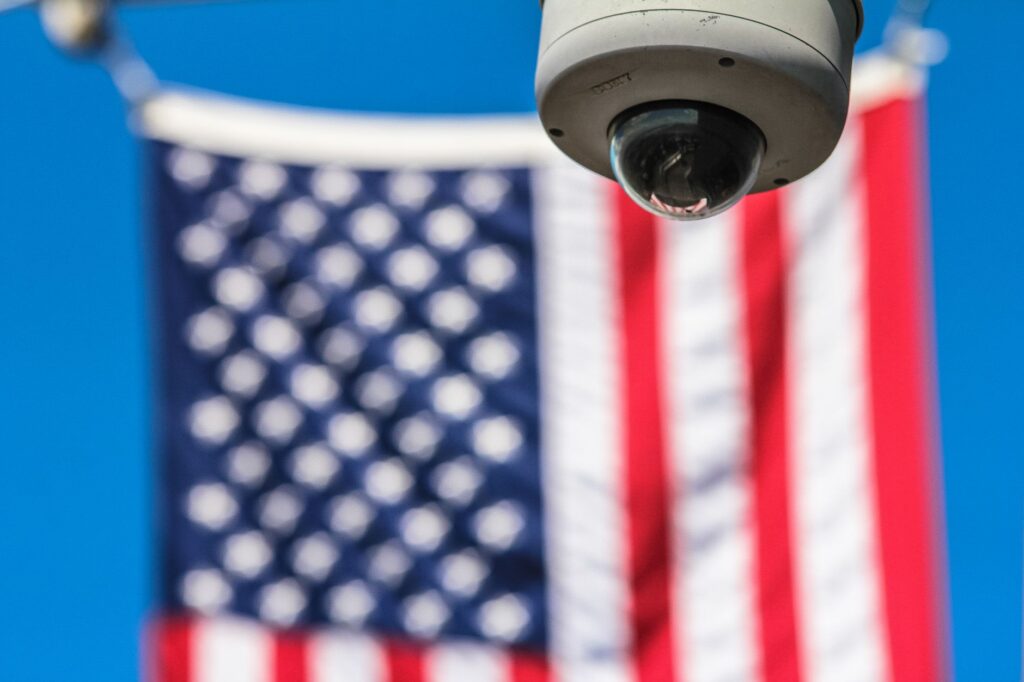
We know the feeling: someone might be watching. Yet it’s often unclear who is doing the watching, what their motive is, and how far the process goes. Surveillance is commonly framed as a privacy issue, but the consequences can ripple outward—toward data theft, targeted disruption of critical sectors, and pressure on governments. And increasingly, AI-powered surveillance accelerates and scales what older methods started.
In this article, we break down surveillance by looking at who uses it, the main techniques involved, and why modern AI changes the stakes. The goal isn’t to panic you—it’s to help you recognize the pattern and understand what protections can realistically exist.
Why surveillance happens in the first place
Surveillance is rarely random. Organizations track and monitor people for a reason, usually tied to their own benefit. That can include selling more effectively, managing employees, investigating threats, or extracting value from victims.
At a minimum, monitoring can undermine privacy. In some cases, it may affect your job prospects, your financial position, or even your civil freedoms. And in every category, the people using surveillance tend to describe it as justified—whether it’s law enforcement, corporate risk control, or criminal targeting.
So the key question is not only “Are we being watched?” but also “What happens to the information afterward, and how accurate or accountable are the systems behind it?”
Surveillance by legitimate companies
Companies often surveil people for two broad reasons: to support sales and to support employer “control.” In practice, those objectives can overlap and grow more invasive as technology improves.
Tracking for sales and advertising
Vendors can monitor behavior across online activity to predict what you might want next. One example discussed in reporting is an AI-powered browser concept aimed at collecting extensive user activity outside the browser’s own interface, with the stated intention of enabling more premium advertising. In that framing, relevance becomes the justification for broad tracking.
Another concern is that AI can be used to comb through material that may include conversations, identifying what is considered valuable for enforcement or for commercial purposes. Separately, observers have raised worries about AI-driven support or mental-health-like applications that may require users to share sensitive information to function as intended.
Beyond browsers, facial recognition cameras have also appeared in the retail context. For instance, reporting from the UK described plans by a supermarket chain to expand facial recognition camera coverage. Supporters may claim benefits like anti-theft, but critics emphasize risks to freedom and privacy for people simply trying to shop.
A related issue is “mission creep”: a technology deployed for one purpose can drift into tracking other behaviors over time, such as buying habits, based on what the installed system enables.
Login and cookies: quieter forms of profiling
Even when you only visit a website, the login flow reveals identity-related signals. If a site sends an activation code by email after you attempt to sign in, that process also confirms whether an email address exists. Over time, those breadcrumbs contribute to profiles about what you looked at and how to contact you.
Cookies are another mechanism. They help websites track which pages you visit and can be used to determine interests. When you view a product but don’t purchase, cookies can drive repeat advertising across other websites. One site can attempt to set many cookies; the exact number depends on how your browser handles or blocks them.
Regulations in many places give users a chance to refuse “non-essential” cookies. However, critics point out that very few users truly know what counts as essential, how the labeling is decided, and how the refusal option is implemented. Some websites make the refusal process complex enough that users accept by time pressure, even if they don’t want tracking.
Surveillance by employers
Monitoring doesn’t stop after you clock in. Employers may track staff mood, often using facial recognition systems. The regulatory landscape varies widely. In the EU, facial recognition is banned in public spaces and restricted for emotion recognition in workplaces, while other regions rely on a patchwork of state or city rules.
Email monitoring is also a common tool. In the EU, it is allowed for specific reasons but restricted for “curiosity” or covert monitoring, although exceptions exist for misconduct investigations, security, and compliance. In the US, email monitoring can be more widespread because there is no overarching federal “right to privacy” in employment. Even so, limitations still exist—such as rules against unauthorized interception—along with exceptions that can narrow practical protection.
As monitoring grows, AI-powered surveillance techniques can extend beyond simple productivity metrics. Reporting highlights that AI can be applied to behavioral analytics, sentiment analysis, meeting participation scoring, keystroke analysis, webcam monitoring, and predictive models intended to detect burnout, insider threats, or employees likely to resign.
Proponents may argue these tools improve security and operations. Critics respond that inferring emotions, motivation, or trustworthiness from imperfect data can cross into invasive surveillance and raise ethical and legal questions. A further concern is that employees may have limited real leverage: even where “consent” is technically possible, refusing can create career consequences.
Surveillance by criminals: stealing context, not just data
Criminals also surveil—but their surveillance is powered by compromise. The initial mechanism is often an infostealer: malware that quietly enters systems, collects relevant data, packages it into logs, and exfiltrates it.
Those logs are then sold to intermediaries known as initial access brokers, which can distribute them to criminal groups. Although infostealers are frequently associated with social engineering, the method can vary. What stays consistent is effectiveness.
Modern infostealers have evolved beyond classic password harvesting. Instead, they act like operational “vacuum cleaners,” often active for a shorter time but stealing credentials and tokens—especially session cookies—so attackers can return and capture more later.
Depending on the target environment, the stolen material may include session tokens, saved credentials, single sign-on and cloud credentials, browser artifacts and system metadata, digital wallet data, and data from messaging and email clients. Malware may also take screenshots, hijack clipboard contents, and perform key logging.
Even if this is technically “theft,” the impact is the same as surveillance: criminals gain insight into what you do, what you access, and how to keep access long enough to monetize it.
Surveillance by law enforcement agencies
Law enforcement often justifies surveillance as necessary for public safety. Supporters argue it can help identify suspects, detect patterns, and respond to threats. Critics agree there are legitimate uses, but they emphasize the core issue: how targeted, accurate, necessary, and accountable the surveillance really is.
Another concern is a chilling effect. Surveillance can influence speech, privacy, and movement—especially when people can’t predict when or how monitoring occurs. Some argue that surveillance should at least be targeted and supported by court orders, rather than applying broadly to people who are not suspected of wrongdoing.
Facial recognition camera networks and data drift
In the US, reporting has focused on “Flock-style” camera systems. The concept originally targeted stolen vehicle identification using number plates. However, critics highlight “usage drift,” where data collection expands beyond the initial purpose: scale increases, retention grows, detail deepens, and the system’s use stretches into domains beyond what was claimed.
According to reporting, this kind of system can create a detailed vehicle fingerprint that includes not only the driver but also passengers. While law enforcement sharing may be expected, concerns extend to how data can be shared with other entities, such as homeowners associations, and how far beyond “stolen vehicles” the collected data may be applied.
Critics also describe the possibility of law enforcement bypassing privacy protections by purchasing data rather than obtaining it through a warrant. That shifts surveillance from a judicially supervised process to a procurement model.
Why aggregation amplifies risk
Surveillance doesn’t operate in isolation. Personal data from social platforms can be scraped, organized into large databases, and analyzed using AI to produce inferences about potential behaviors. If data exists in aggregated markets, it becomes easier—at least in theory—for multiple actors, including law enforcement and intelligence services, to access it.
Additionally, surveillance may compound when separate datasets are fused together. That enables “very private details” to emerge—such as patterns of visits to places tied to health, religion, or personal routines.
Intelligence agencies and international data sharing
Intelligence organizations may frame surveillance as protection against adversaries. Yet the process becomes more complex when data sharing crosses borders.
Reporting highlights the Five Eyes arrangement, a cooperation group between intelligence agencies in the US, Canada, the UK, Australia, and New Zealand. The central theme is sharing intelligence information, which can create a pathway from domestic surveillance to foreign intelligence analysis.
Because cooperation relies on purpose and information exchange habits, surveillance conducted in one jurisdiction can effectively become accessible to multiple partners—even if each organization has different formal constraints.
AI and large-scale data aggregation also make it harder to prevent overreach. Open-source intelligence, leaked datasets, social media artifacts, breached credentials, location metadata, financial records, facial recognition signals, and purchased commercial data can be fused into detailed digital profiles—at speed and at scale.
How AI supercharges surveillance—and what can go wrong
AI-powered surveillance changes the tempo and the scope. Instead of collecting targeted data first and then analyzing it, AI systems can encourage collection at large volumes and then flag patterns that appear suspicious through algorithms.
This creates risks: false positives, biased outcomes, and innocent people becoming investigation subjects due to statistical “oddities” that don’t reflect wrongdoing. Critics argue that AI models often bring bias issues related to race, political ideology, or religion, and that errors can have serious consequences when the system influences real-world decisions.
There is also a broader governance concern. When an algorithm produces an assessment, it can create an illusion of mathematical objectivity—turning an inference into something that feels like a fact, even if it’s based on biased training data or flawed assumptions. Without transparency and accountability, those outputs can become difficult to challenge.
Finally, the AI system itself becomes an attack surface. To detect threats such as prompt injection or agent hijacking, monitoring may require logging sensitive internal interactions—like tool calls, operator conversations, and reasoning traces. Those traces are sensitive by design, which means the “defense” can create another layer of exposure.
What defenses actually exist
In the source framing, the main defenses are regulation and public awareness. Regulation matters because it can limit when and how surveillance is allowed, require targeted approaches, and define what counts as essential versus non-essential tracking.
Awareness matters because people can only defend what they understand. When users know which signals are being collected—logins, cookies, device identifiers, camera capture, or monitoring dashboards—they can make more informed choices and push for stronger accountability.
At the same time, accountability is essential for workplaces and public agencies. If automated systems affect hiring, pay, promotion, or accusations, decision-makers should be able to demonstrate that systems are accurate, fair, tested, and explainable—not just that data was collected.
Conclusion
AI-powered surveillance is not one single technology—it’s a growing ecosystem of methods used by companies, criminals, law enforcement, and intelligence services. Each group may claim a different purpose, but the pattern is consistent: data is collected, analyzed, and then used in ways that can affect privacy, employment, finances, freedom, and national interests.
To navigate this reality, focus on transparency, enforceable limits, and real accountability. Combine that with personal vigilance—so you can recognize surveillance signals early and respond before they become normalized.
Source: https://www.securityweek.com/surveillance-everything-you-wanted-to-know-but-were-afraid-to-ask/